


The Forgotten Smoke: When Tillsonburg Rolled 27,000 Cigars a Week
When most people think of Tillsonburg’s past, tobacco fields and Stompin’ Tom’s aching back come to mind. But few know that long before flue-cured tobacco became king, our town made its mark with something a little more refined: fine, handmade cigars.
Yes — Tillsonburg once had a cigar factory. And not just any small shop. In the early 1880s, the town’s Broadway was home to a thriving operation that rolled thousands of cigars a week, earning Tillsonburg a place alongside cigar giants like Montreal, Hamilton, and Windsor.
A Local Visionary and a Boom in Smoke
The story begins with Farnsworth & Son, an early cigar-making venture that laid the foundation for what came next. In 1881, the business was purchased by a local entrepreneur named J.Z. Leach. Known at the time as a dealer in pianos and organs, Leach saw a new opportunity — and he seized it.
Leach moved the cigar factory to a storefront on Broadway, placing it in the heart of town. Within two years, it had grown from a modest workshop into a bustling workplace of over 50 men, women, and children, rolling cigars by hand in the back, with storefront sales out front.
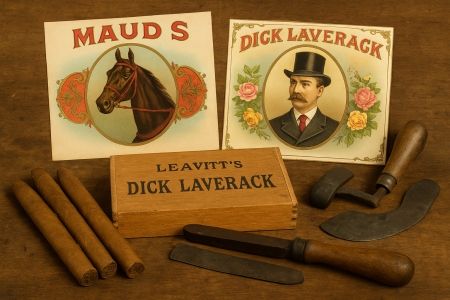
At its peak, the factory was churning out a staggering 27,000 cigars a week, including brands with names like “Maud S” and “Dick Laverack.” These names might sound strange now, but they were popular labels, often inspired by racing horses or notable figures of the time.
A Sudden End
Unfortunately, Tillsonburg’s cigar boom was short-lived. In March 1883, just as the factory was hitting its stride, J.Z. Leach died suddenly at the age of 42. The business could not continue without him, and the factory closed soon after his passing.
But even in its brief life, the factory made an impression. It offered local jobs, spurred economic activity, and brought Tillsonburg into Ontario’s cigar-making spotlight — if only for a moment.
Lost to Fire and Time
So what became of the building itself?
Historical records confirm that the cigar factory was located somewhere along Broadway, likely near the blocks between Ridout and Brock Streets. Unfortunately, in June 1903, a massive fire swept through downtown Tillsonburg. Only two buildings in that stretch survived. The factory site, like many others, was lost in the blaze and replaced by newer brick structures in the years that followed.
No signage remains. No plaque marks the spot. Yet beneath the modern storefronts of Broadway, history lingers — in the air, in the archives, and in the stories passed down.
The Tobacco Legacy Lives On
Though the cigar factory vanished, its story didn’t end there. The 20th century brought a different kind of tobacco boom to Tillsonburg. Flue-cured tobacco, better suited for cigarettes, became the crop of choice. In the 1920s and beyond, local farms flourished, warehouses sprang up, and tobacco auctions buzzed with energy.
Tillsonburg became a central hub in Canada’s Tobacco Belt. The hard work of harvesting — especially priming the sticky lower leaves — became part of the region’s identity. It even earned a place in Canadian folklore with “Tillsonburg”, Stompin’ Tom Connors’ gritty, unforgettable song that immortalized the back-breaking labour of tobacco picking.
Remembering the First Smoke
Today, the story of Tillsonburg’s cigar era lives on in places like the Annandale National Historic Site and the Delhi Tobacco Museum & Heritage Centre, which preserve artifacts and memories from the early tobacco days.
So the next time you stroll along Broadway, look around. Somewhere beneath your feet, workers once sat at benches, carefully rolling cigars under oil lamps. Somewhere above, the scent of tobacco once drifted out open windows.
It was a short chapter — but a rich one. And it’s worth remembering.


